Who this guide is for
This is written for the person who signs off the towel order: hotel and resort procurement, housekeeping managers who have to defend the linen budget, and group purchasing teams standardising towels across several properties.
It assumes you already know what a towel is. What it gives you is the decision order — which four numbers to fix first, which constraint decides the rest, and how to compare quotes from suppliers who are all describing their product differently.
The specification is four decisions and one constraint
A hotel towel specification looks like a long list and is actually short. There are four decisions you make, and one constraint that removes most of the options before you start.
The four decisions are: weight (GSM), size, cotton type and border or selvedge construction. The constraint is your laundry — specifically the maximum wash temperature and whether the bleach is chlorine-based or oxygen-based.
Get the order right and the specification writes itself. Fix the constraint first, because chlorine bleach eliminates most dyed shades and pushes a property toward white. Then fix weight, because weight is the decision guests feel and the one that most directly trades against service life. Then size, driven by the room type. Construction last, because it is where two suppliers quoting the same weight and size will differ.
What most properties actually do is the reverse: they start from a previous order, adjust on price, and discover the laundry constraint two years later when the coloured towels have gone patchy.
Three towel territories inside one property
The most useful structural decision a hotel makes is to stop buying "towels" as one category. A property normally runs three separate towel programmes with different requirements, and blending them into one specification is why the pool towels always look tired while the room towels are still fine.
Guest room towels are the ones a guest forms a judgement about. They need to feel substantial, look consistent across hundreds of rooms, and survive the highest number of wash cycles in the property because they are turned over most often. This is where weight and border construction matter most.
Pool and beach towels are the ones that get abused. They are used outdoors, sat on, taken to the beach, and washed with sand and sunscreen in them. They need higher abrasion resistance and a colour plan that tolerates chlorine and sun exposure. Weight matters less than durability and drying speed, because pool towels are turned around fastest.
Spa and treatment towels are the ones with the tightest dimensional requirement. They are folded, stacked and used in fixed positions on a treatment bed, so a two-centimetre variation shows. They are also usually the smallest and the most frequently replaced, because treatment products stain them.
Where a property runs a single towel specification across all three, it is almost always the pool towels driving the replacement cycle and the room towels paying for it. Separating the three programmes is usually the single largest saving available in a hotel towel budget.
| Programme | Driven by | What to fix first |
|---|---|---|
| Guest room | Guest feel and wash cycle count | Weight, then border construction |
| Pool and beach | Abrasion and drying speed | Fibre durability, then colour plan |
| Spa and treatment | Exact folding dimensions | Size tolerance, then stain resistance |
GSM: what the number tells you and what it does not
GSM is the weight of the fabric in grams per square metre. It is the first number in any towel specification and the one that correlates most directly with how substantial a towel feels in the hand.
It does not tell you how well the towel will wear. Two towels at the same GSM can be built from very different yarns, and the finer-yarn version will feel better and abrade faster. GSM measures mass, not construction quality.
Hotel towels commonly sit in a range from about 400 GSM for lighter pool and gym towels up to around 700 GSM for heavier guest room towels, with spa towels often lighter because they need to dry quickly between treatments. Within that range, the choice is a straight trade: heavier towels feel better to a guest on arrival and take longer to dry, which matters both to your laundry throughput and to how the towel performs in a humid bathroom.
There is a second number that matters almost as much and is rarely stated: pile height. A towel can reach a given GSM with a shorter, denser pile or a longer, looser one. The denser pile usually feels firmer and wears better; the longer pile feels plusher when new and mats faster. Specify which you want rather than assuming the weight settles it.
If you can only put two fabric numbers in the specification, use GSM and pile construction. Those two, plus the target wash cycle count with the laundry conditions attached, will predict service life far better than any marketing description of softness.
Sizes: the room set, the pool set and the spa set
Towel sizes follow from the room type and the guest expectation rather than from a national standard, and hotels vary more than hospitals do. What matters is stating finished dimensions including the shrinkage allowance, and stating them per programme rather than as a single house standard.
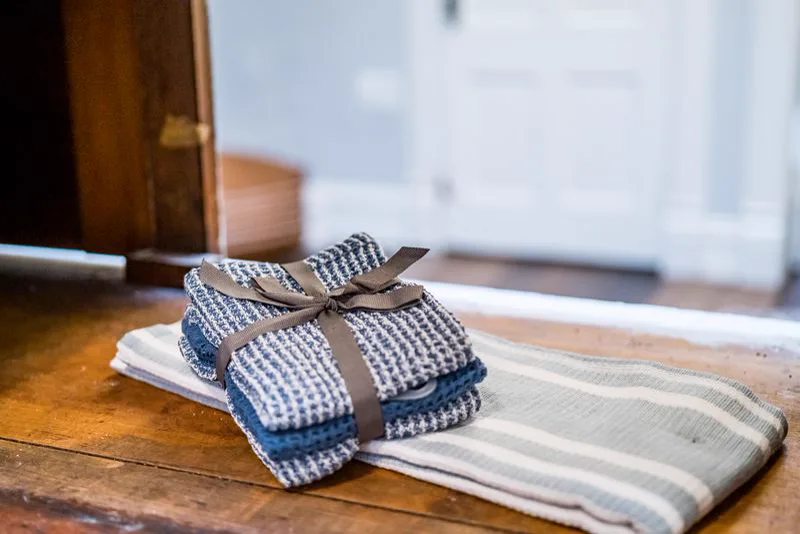
The guest room set normally has three pieces: a bath towel, a hand towel and a washcloth or face cloth. Larger properties add a bath sheet or a bath mat in suites and premium rooms. Sizes in the room set are chosen so that the bath towel wraps around an adult guest without a gap — that is the practical test, and it is worth folding a sample on a person rather than measuring it on a table.
Pool towels are usually larger than room bath towels and often thinner. The point is coverage on a lounger, not absorbency after a shower, and a lighter, faster-drying towel is usually the better choice even though it feels less luxurious.
Spa and treatment towels are the exception to almost every general rule. They are small, they must fold to an exact dimension for the treatment bed or the towel warmer, and they are replaced on a stain cycle rather than a wear cycle. Specify them last and separately, because forcing them into the room towel specification will over-specify the fabric and under-specify the dimensional tolerance.
For all three, state finished dimensions and the shrinkage allowance as two separate numbers. A towel quoted at a nominal size that arrives two centimetres smaller has not necessarily been made wrongly — it may be that the allowance was folded into the size without either side saying so, and that ambiguity is worth removing permanently.
Cotton type: standard, combed, Egyptian, Turkish
Cotton type is the most oversold variable in towel specification and the easiest to overpay for, because the differences are real but smaller than the price difference suggests.
Standard cotton is the baseline: carded cotton with a proportion of shorter fibres. It is absorbent, durable and the least expensive, and for pool and utility towels it is usually the correct answer.
Combed cotton has had the shorter fibres removed before spinning. The result is a smoother, stronger yarn that pills less and feels softer at the same weight. For guest room towels, combed cotton is the upgrade that guests actually notice.
Egyptian and Turkish cotton are longer-staple cottons grown in specific regions. Longer staples mean finer yarns can be spun without losing strength, which produces a lighter towel that feels softer. The benefit is real, and so is the cost. Whether it is worth it depends on how much of your guest mix would notice — in a four or five star property it is usually defensible; in a mid-market property the same money spent on higher GSM combed cotton will be noticed by more guests.
Where towels are laundered aggressively, the fibre choice matters less than the construction and the target wash cycle count. Long-staple cotton in a loosely piled towel will still mat and thin on the same schedule as standard cotton.
| Cotton type | What changes | Where it pays |
|---|---|---|
| Standard / carded | Baseline absorbency and durability | Pool, utility and back-of-house |
| Combed | Smoother yarn, less pilling, softer at same weight | Guest room towels |
| Egyptian / Turkish long-staple | Finer yarn, softer and lighter at same weight | Premium and suite categories |
Colour retention: why white dominates and what happens to colour
In hospitality, white dominates towel programmes for operational reasons rather than aesthetic ones. White can be washed at high temperature, it can be bleached when it is stained, and it keeps a property looking consistent across hundreds of rooms even when individual items are at different points in their life.
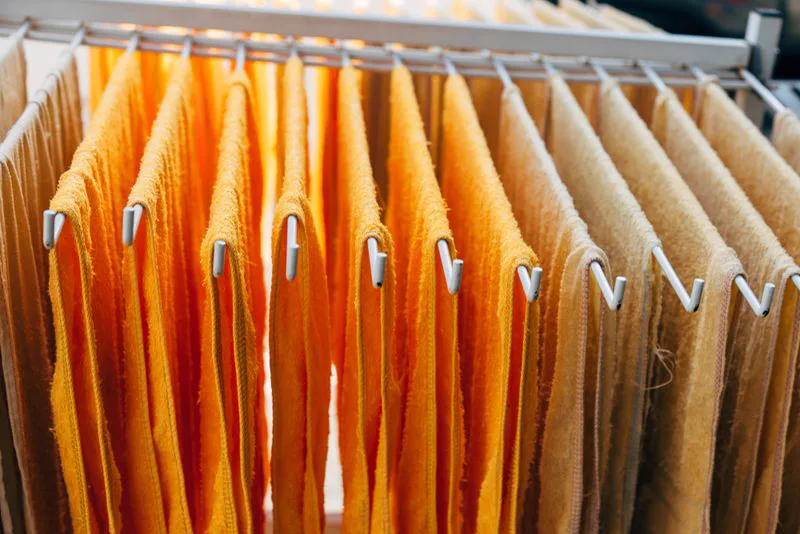
Colour earns its place in specific programmes: spa and wellness, pool decks, gyms, and branded suites where a navy, a grey or a terracotta carries the property identity. Colour also hides the stains that white cannot, which is why spa and treatment towels are often coloured even in properties that are otherwise all white.
The critical variable is bleach chemistry. Chlorine bleach attacks dyed cotton progressively and unevenly. A coloured towel in a chlorine system does not fade evenly — it goes patchy, with the areas that see most abrasion losing colour first. The practical result is that a property running chlorine bleach is effectively committed to white room towels, and should treat any coloured towel as a consumable with a short, predictable life.
Facilities running oxygen-based bleach systems have far more shade freedom, but oxygen systems typically need higher temperatures and longer dwell times, which changes both the energy profile and the throughput of the laundry.
Where colour is used, specify the shade by a reference the supplier can match and state a tolerance. Two deliveries of the same "grey" from the same supplier can be visibly different, and mismatched towels in one bathroom are visible to a guest even when every individual towel meets its own specification.
Laundering: the two ways hotel towels die
Hotel towels fail in two distinct ways, and knowing which one you are experiencing tells you which specification variable to change.
The first is pile loss. The loops wear away, the towel becomes thinner, and absorbency drops because there is less surface to absorb with. Pile loss is driven by mechanical abrasion in the wash and by over-drying, which makes the fibres brittle. If your towels are going thin before they go stiff, the answer is usually construction and drying practice rather than a heavier towel.
The second is loss of softness. The towel stays thick but becomes harsh and scratchy. This is normally a laundry chemistry problem rather than a fabric problem — residual detergent, inadequate rinsing, or hard water deposits leaving mineral residue in the pile. Buying a heavier towel to solve a harshness problem spends money on the wrong variable, and the new towels will go harsh on the same schedule.
There is also a third failure that is really a specification failure: the towel is still structurally sound and still soft, but the colour has gone. In a chlorine system that is expected and should be planned for; in an oxygen system it usually means the dye class was wrong for the chemistry.
Because the failure mode differs, the specification should carry a target expressed the same way: the number of industrial wash cycles the towel must survive with the temperature and chemistry conditions attached. A cycle count without conditions is not comparable between suppliers, and the conditions matter more than the number.
The gram-loss question
Buyers sometimes specify towels by permitted weight loss over a laundering life — a towel that starts at a given GSM and must not fall below a stated percentage after a stated number of washes.
It is a reasonable instinct, and it is worth understanding what it measures. Weight loss in laundering comes mostly from fibre loss through abrasion and from the removal of any surface treatments applied at manufacture. A towel that has been softened or finished for show-room feel will lose more weight early, because the treatment is coming off, and that loss is not the same as losing structure.
The practical way to use the number is as a comparison between candidate suppliers under identical wash conditions rather than as an absolute pass or fail. Ask each supplier for their figure with the conditions attached, and treat a supplier who cannot state the conditions as a supplier who cannot state the number.
Where you do not have the facility to run a comparative wash trial, the simpler proxy is the pre-production sample washed at your own laundry conditions a set number of times, measured before and after. That single test resolves more specification arguments than any amount of supplier documentation.
Border, selvedge and the details that show quality
Two towels can carry the same GSM, the same size and the same cotton type and still differ visibly and in service life. The difference is in the edges and the finish.
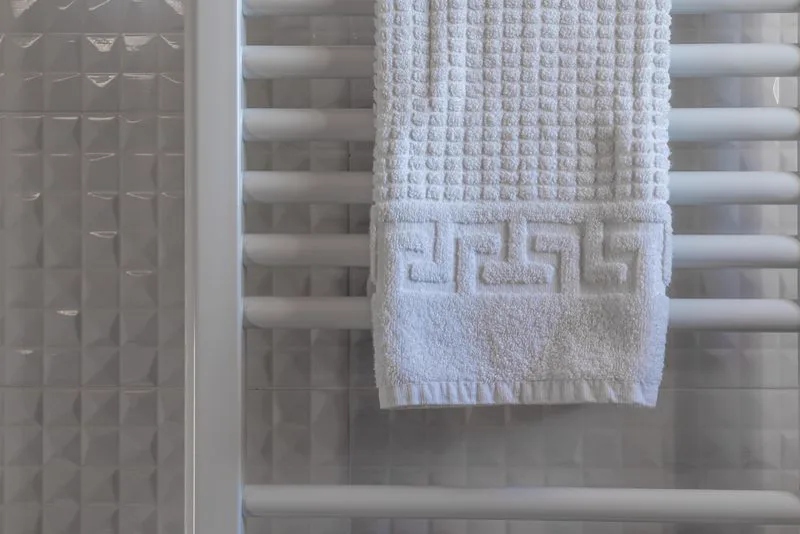
The border construction is the most visible. A dobby border — a woven band near the ends — gives a towel a defined edge and is the standard on guest room towels in most properties. A cam or plain border is simpler and cheaper and common on utility towels. The border also affects how the towel hangs and how it looks when folded in a stack, which matters more in a hotel than in most other settings.
The side selvedge is where a towel fails first. A narrow, loosely finished selvedge frays and can begin to unravel within the first dozen washes. Specify the selvedge width and finish, and be aware that this is one of the most common places where two apparently identical quotes differ.
The hanging loop is a small detail with a real housekeeping consequence, and it is worth specifying whether you want one, where it sits and how it is attached rather than leaving it to the supplier.
Wash-care labelling and any traceability requirement belong in the same part of the specification. If you intend to track towels through their service life, decide the tag type and position before production, and keep the position clear of the highest-abrasion zone.
How to compare towel quotes like for like
Towel quotes are unusually hard to compare, because suppliers describe products in different vocabularies. One quotes by GSM, another by weight per dozen, another by yarn count. None of them is wrong, and the three cannot be compared until they are normalised.
Ask every supplier to state the same set of facts in their quote, and treat an unanswered item as information rather than a gap to fill in yourself.
Only once all eight items are present for all your candidates does a price comparison mean anything. In practice, doing this exercise usually changes which quote is lowest, because the lowest headline price frequently belongs to the quote with the shortest stated service life.
- GSM stated, plus pile construction and pile height
- Cotton type named precisely, including whether it is combed
- Finished dimensions, with the shrinkage allowance stated separately
- Border construction and selvedge specification
- Target wash cycle count with the temperature and chemistry conditions attached
- Pieces per pack, packs per carton, carton dimensions and gross weight
- Lead time stated from order confirmation or from artwork approval — these are different dates
- Payment and shipping terms, so that the landed cost is comparable
Sampling and bulk checks for towels
A towel sample should be used to test the specification, not to admire the product. Ask for the pre-production sample to be made from the same yarn lot and the same construction as the bulk order, and say so explicitly, or you will be evaluating a prototype.
Then test it against the written specification rather than against your impression. Measure it. Weigh it. Wash it at your own laundry conditions a set number of times, then measure and weigh it again. A towel that measures correctly and loses more weight than expected has told you something a photograph cannot.
Before dispatch, ask for photographs of the finished towels and the packed cartons with the shipping marks visible. This is a low-cost check that catches labelling and packing errors before they cross a border.
On receipt, check three things before the shipment is distributed to housekeeping: carton count and carton condition, the finished dimensions of a sample against the approved sample, and the shade of a sample against the reference. A discrepancy found at this stage is resolvable. The same discrepancy found after the towels have been distributed across twelve floors is not.
Six towel specification mistakes that cost the most
These are the errors that show up repeatedly in hotel towel procurement, roughly in descending order of cost.
- Buying one towel specification for room, pool and spa. The pool towels drive the replacement cycle and the room towels pay for it.
- Specifying GSM without pile construction. Two towels at the same weight behave differently, and the number alone does not settle it.
- Leaving bleach chemistry out of the specification. Guarantees a colour failure inside the first year and makes it look like a manufacturing fault.
- Solving a harshness problem by buying a heavier towel. Harshness is usually a rinse or water-hardness issue, and the new towels will go harsh on the same schedule.
- Using a show-room sample as the standard. Softener finish comes off in your laundry and the delivered towel will not feel the same.
- Comparing quotes on unit price alone. The lowest unit price frequently belongs to the quote with the shortest stated service life.
Writing the towel RFQ
If you send one document to suppliers, send this structure. It produces comparable quotes, and it also tests the supplier, because a supplier who cannot answer these questions in writing is telling you something useful about how the order will go.
Put the laundry conditions before the product description. Suppliers who receive the performance requirement first tend to quote to the requirement; suppliers who receive the fabric description first tend to quote what they already stock.
- Property type and room count, plus the number of towels per room set
- The three programmes being ordered, with quantities per programme per year
- Laundry conditions: maximum wash temperature, bleach chemistry, expected cycles between replacement
- For each programme: GSM, pile construction, cotton type, finished dimensions with allowance
- Colour: shade reference and tolerance, or "white only"
- Border and selvedge specification, and hanging loop requirement
- Labelling and traceability requirement, or "none"
- Packing requirement, shipping terms and the required delivery date
- Sample requirement: pre-production sample from production yarn lot, yes or no