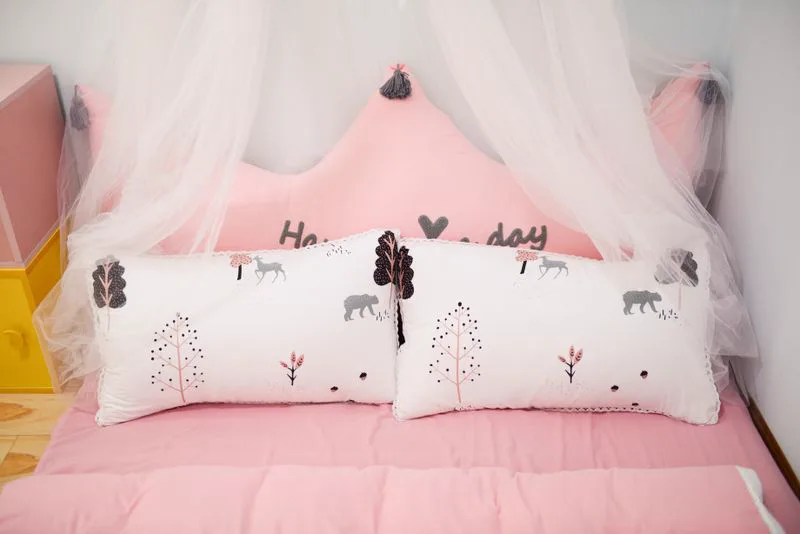
A star rating is not a specification
Hotel bed linen is sold against tiers — three star, four star, five star — as though the tiers described something measurable. They do not. A star rating is an assessment of a property’s facilities and service, and it says nothing about the fibre, weight or construction of the sheets on the beds.
What actually changes as you move up a property’s linen specification is a small number of variables, and they change independently. Understanding which is which is the difference between spending money where a guest notices and spending it where only the invoice notices.
There are five variables worth separating: fibre and yarn, weight, finish, construction, and colour management. Each has a different cost curve and a different visibility to a guest.
Variable one: fibre and yarn
Fibre is where the price differences are largest and where guest perception is most reliable — but only up to a point.
Standard cotton has a proportion of shorter fibres. It is absorbent, durable, and the least expensive. Combed cotton has had the shorter fibres removed before spinning, giving a smoother, stronger yarn that pills less and feels softer at the same weight. Long-staple cottons produce a finer yarn again, so the fabric feels lighter and softer without giving up strength.
The guest-facing difference between combed and standard cotton is noticeable. The difference between combed and long-staple is noticeable to some guests and not to others, and the price gap is considerably wider.
There is a second variable inside the yarn that no marketing term captures: yarn count. Two fabrics at the same weight can be built from very different yarns, and the finer-yarn version feels better and abrades faster. If you are moving up a tier for feel, ask what the yarn count is; if the answer is the same as the tier below, you are paying for a label.
| Fibre route | What changes | Where it earns its cost |
|---|---|---|
| Standard carded cotton | Baseline durability and absorbency | Mid-market and high-turnover properties |
| Combed cotton | Smoother yarn, less pilling, softer at same weight | Most four-star guest rooms |
| Long-staple (Egyptian, Turkish, Supima) | Finer yarn, softer and lighter at same weight | Suites and premium categories |
Variable two: weight
Weight in GSM is the variable a guest registers most immediately and understands least. A heavier sheet feels more substantial the moment someone sits on the bed, before they have formed any view about the fibre.
This makes weight the most cost-effective upgrade in the whole specification — up to the point where the laundry becomes the constraint. Heavier fabric takes longer to dry and holds more water, so a property that increases GSM without checking its drying capacity will find throughput falls before the guest notices the difference.
Weight also trades against service life. At the same fibre and construction, a heavier sheet generally lasts longer because there is more fibre to abrade. But a heavier sheet made from a coarser yarn can wear faster than a lighter sheet made from a better yarn, so weight should not be specified in isolation.
The practical approach is to fix weight first, because it is the lowest-cost visible improvement, then decide whether the remaining budget goes into fibre or into construction. In most properties the answer is construction, because that is where guests form a view about quality without knowing they have.
Variable three: finish
Finish is the least understood variable and the one most often paid for without benefit.
Calendering presses the fabric smooth under heat and pressure and improves the hand feel when new. It is a surface effect and it diminishes over the first several washes. A specification that relies on calendering for its perceived quality is specifying something that disappears — and if the property buys on a show-room sample, that is exactly what it is buying.
Mercerising treats cotton with caustic soda, increasing lustre, strength and dye uptake. This is a change to the fibre rather than a surface coating, and it survives laundering. Where a property wants a genuine improvement in appearance that does not wash out, mercerising is the finish to specify.
Optical brightening makes white fabric read whiter under artificial light, and it interacts with bleach chemistry because brighteners are consumed over successive washes. Specify it as a yes or no, because it affects how the linen looks at cycle eighty rather than how it looks on arrival.
Sanforising mechanically reduces residual shrinkage, so the finished item moves less in service. Where a property wants tight dimensional tolerance across a large room count, this is worth naming explicitly rather than assuming it is included.
Variable four: construction
Construction is where two quotes with identical fibre, identical weight and identical size differ, and it is where the guest forms a judgement without knowing it.
Hem width and fold. A wider double-folded hem takes longer to fail and reads as a more considered product when the bed is turned down. The difference in cost per piece is small; the difference in appearance and in cycles is not.
Stitch density. Higher density is not automatically better. Very high stitch density in the wrong fabric perforates it and creates a tear line, so the correct density depends on the fabric as well as the load.
Corner construction on fitted sheets. A boxed or mitred corner holds shape and survives the load; a simple sewn corner does not. On a hotel bed, a fitted sheet that lifts at the corner is immediately visible to a guest.
Border and trim where present. Any decorative detail is also a point of failure, so a specification that adds trim should also specify how it is attached and what the laundering conditions do to it.
If a property is choosing between spending its next increment of budget on fibre or on construction, construction usually delivers more guest-visible improvement per unit of cost.
Variable five: colour management
Colour sits oddly in a tier discussion because it is not a quality variable at all — it is an operational one. And it is the variable most often decided badly.
Where the laundry uses chlorine bleach, most colour decisions have already been made. Chlorine attacks dyed cotton progressively and unevenly, so coloured linen in a chlorine system goes patchy rather than fading uniformly. The practical result is that the property is effectively committed to white for high-turnover items and should treat coloured items as consumables with a short life.
Where colour is used — for room categories, for a brand identity, or for spa and pool programmes — specify the shade by a reference the supplier can match and state a tolerance. Two deliveries of the same cream from the same supplier can be visibly different, and mismatched linen within one room is visible to a guest even when every item meets its own specification.
This is the variable where a group with several properties should centralise the decision. Matching white across properties is straightforward; matching a stone or a sage across successive deliveries is not, unless one shade reference and one tolerance apply across the group.
Where the money is wasted
These are the linen spend decisions that reliably fail to deliver guest-visible value.
- Buying long-staple fibre into a laundry that will abrade it on a mid-market schedule. The fibre wears out on the same clock as the cheaper option.
- Specifying calendered finish because a show-room sample felt good. The finish is a surface effect and comes off in your wash.
- Adding GSM to solve a harshness complaint. Harshness is normally a rinse or water-hardness issue, and the heavier sheets will go harsh on the same schedule.
- Buying a heavier towel or sheet to fix a fit problem. Fit is a dimension question, not a weight question.
- Specifying a tier the laundry cannot sustain. This is the expensive one, because the whole order fails on the laundry’s clock rather than the specification’s.
- Upgrading the fibre while leaving the construction at the bottom tier. Guests notice hems and corners more than they notice yarn count.
Matching the specification to the property, not the star rating
The right tier for a property is determined by three things, none of which is the star rating on the door.
The guest mix. A property whose guests are predominantly one-night business travellers will get less value from premium fibre than one whose guests stay three nights for leisure. The second guest touches the sheets far more often and forms a stronger impression.
The laundry. This is the binding constraint. A property with an older laundry running high temperatures and chlorine bleach cannot sustain a delicate long-staple sheet, no matter what the brand standard says. Where the laundry is the constraint, the productive investment is in the laundry rather than in the linen.
The replacement budget. Premium fibre has a shorter abrasion life in a hard wash. A property that upgrades the fibre without increasing the replacement budget will simply be replacing expensive linen on the same schedule as cheap linen, which is the worst of both outcomes.
A property that answers these three questions honestly usually finds that its correct tier is one step below what its brand standard implies, with the difference spent on construction and on laundry capability instead.
Testing a tier upgrade before committing
A tier upgrade is a recurring cost, so it is worth testing before it becomes a standing order.
Buy a pre-production sample of the proposed tier and a sample of the tier currently in use, both from production fabric. Measure both, wash both at your own conditions for the same number of cycles, and measure both again.
Track dimensional change, weight change and appearance at the hems and corners. Then put both on a bed, turn the bed down, and look at them side by side under room lighting rather than laundry lighting.
The result is usually informative in one of two directions. Either the upgrade is visible in the room and worth the recurring cost, or it is visible only under show-room lighting and the money is better spent elsewhere. Either way you will know before you commit a year’s linen budget.
Writing the hotel bed linen RFQ
Send the laundry conditions before the product description. Suppliers who receive the performance requirement first quote to the requirement; suppliers who receive a fabric description first quote what they stock.
- Property type, room count and room categories
- Guest mix and average length of stay
- Laundry conditions: maximum temperature, bleach chemistry, expected cycles between replacement
- Item list with quantities per item per year
- Per item: fibre as percentages and yarn type, GSM, finished dimensions with allowance separate
- Finish requirement: mercerised, sanforised, brightened, calendered — stated explicitly
- Construction: hem width and fold, stitch density, corner construction, bar-tack positions
- Colour: shade reference and tolerance, or "white only"
- Packing and shipping marks, per property if a group order
- Required delivery date, and the date the order will be placed